The Triumphal Entry | Luke 19:28-44
Jesus as King is at the heart of this story. But Jesus also clarifies exactly what kind of King he is. So many of his followers expected a conquering king who would oust the foreign government. But instead of a conquering king, Jesus comes to bring peace.
Jesus as King is at the heart of this story. But Jesus also clarifies exactly what kind of King he is, because so many of his followers had wrong expectations of what that kingship would look like.
They, of course, hated Roman rule, this enemy who was occupying and ruling over Israel. So they wanted a Messiah who would throw off those foreign rulers and establish a Jewish nation under Jewish laws and governance. That would require the Messiah to be a conqueror, a commander who would come in with military might to expel the foreigners from the land.
Jesus himself paints a picture of how a conqueror would enter the city like Jerusalem at the end of this story. “For the days will come upon you, when your enemies will set up a barricade around you and surround you and hem you in on every side and tear you down to the ground, you and your children within you. And they will not leave one stone upon another in you, because you did not know the time of your visitation” (Luke 19:33-34).
Even though the Triumphal Entry is mentioned in all four gospels (Matthew 21, Mark 11, and John 12), only Luke includes Jesus weeping over the destruction that will happen in Jerusalem one day.
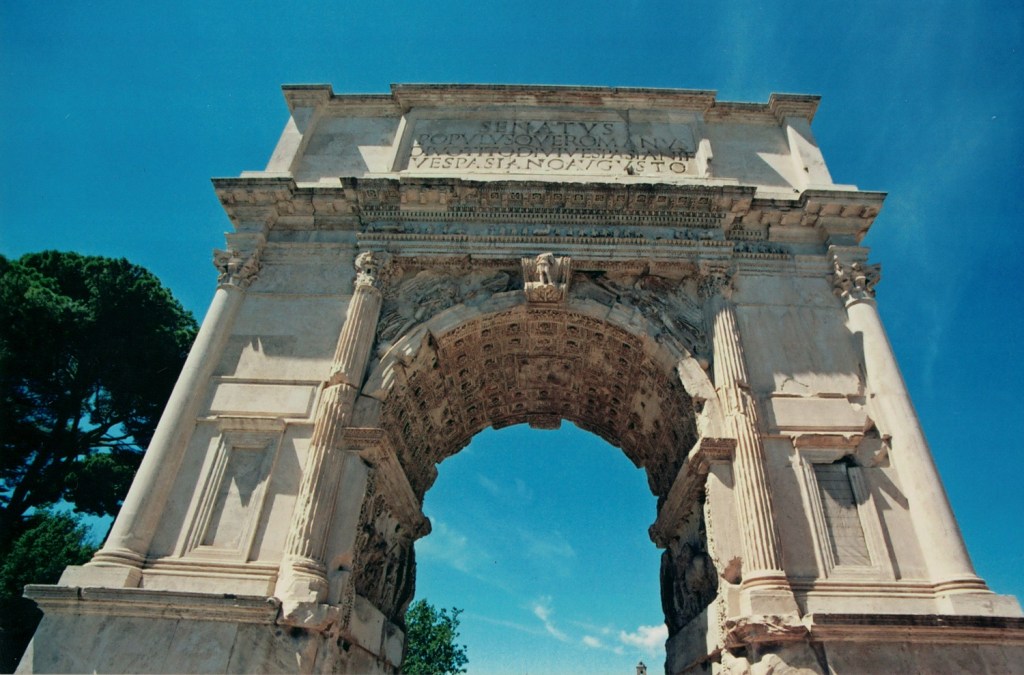
This description of how a conqueror would come into Jerusalem actually takes place about 30 years after this, in 70 AD, when Titus, a Roman general who later becomes the emperor, lays siege to Jerusalem for five months. And at the end of that time, he totally destroys the city and the temple. To celebrate this victory, Titus was given a triumph in Rome. This was essentially a parade where the conqueror would wear a laurel crown and a purple toga. He would ride in a chariot, followed by his army and the captives and spoils of war. Afterward, the conqueror would offer sacrifices to Jupiter, the highest god of Rome.
Titus even had two arches built to commemorate his victory in Jerusalem, one of which is still standing today. So that’s what a Roman conqueror in Jesus’ day would have looked like.
Jesus’ entry into Jerusalem, while clearly signaling his kingship, looked very different from a conqueror like Titus. Instead of a chariot pulled by four horses, Jesus comes in on a donkey, an animal of peace, not war. And arriving on a donkey was no accident: it was prophesied hundreds of years before this in Zechariah 9:9.
Instead of Jesus wearing a purple and gold toga, his disciples threw their cloaks onto the road in front of him. And instead of offering a sacrifice to a false god, Jesus would, in five days, offer himself as the ultimate sacrifice to the one true God.
Jesus was showing himself to be a different kind of king, a peaceful king. And that is our key truth for today. Jesus is the peaceful king.
We see this emphasized throughout the story. Jesus rides on a donkey, and the people, as they praise God say, “Peace in heaven and glory in the highest.” Jesus talks about Jerusalem, longing that they would know the things that would bring them peace.
We’ve seen peace mentioned throughout the Book of Luke. When Jesus was born, the angels sang “Glory to God in the highest and peace on earth to men on whom his favor rests.” Several times when Jesus heals people, he sends them away saying, “Go in peace.”
Jesus came not to conquer people or places, but to conquer sin and death and the devil. Romans 6:10 tells us “For the death he died he died to sin, once for all, but the life he lives he lives to God.”
Hebrews 2:14-15 tell us that “Since therefore the children share in flesh and blood, he himself likewise partook of the same things, that through death he might destroy the one who has the power of death, that is, the devil, and deliver all those who through fear of death were subject to lifelong slavery.”
Colossians 2:15 says, “He disarmed the rulers and authorities and put them to open shame, by triumphing over them in him.”
And Romans 5:1 says, “Therefore, since we have been justified by faith, we have peace with God through our Lord Jesus Christ.”
Notice the emphasis in each of these verses on Jesus’ death and the cross. We know from our experiences of the world today that peace does not come easily. It’s a struggle, it’s costly. Jesus came as the peaceful king, giving his life in order to give us peace with God. That’s what it cost him.
Today as you go, if you have not yet trusted in Jesus to give you peace with God, do it today. Don’t live without peace any longer. Trust that Jesus’ death and resurrection paid the penalty for your sins, giving you peace with God.
For those of you who have trusted in Christ, I want you to spend some time today praying for peace. Jesus has promised us his peace in John 14:27, “Peace I leave with you, my peace I give you.” But so often we lose sight of that peace. Pray for it today.
Pray for peace in the world. Pray for peace in your relationships with one another. Pray for peace in your own heart for the things that you are anxious and troubled about.
Because Jesus is the Peaceful King.
 Amy C Walters
Leave a comment