The Parable of the Sower | Luke 8:4-15
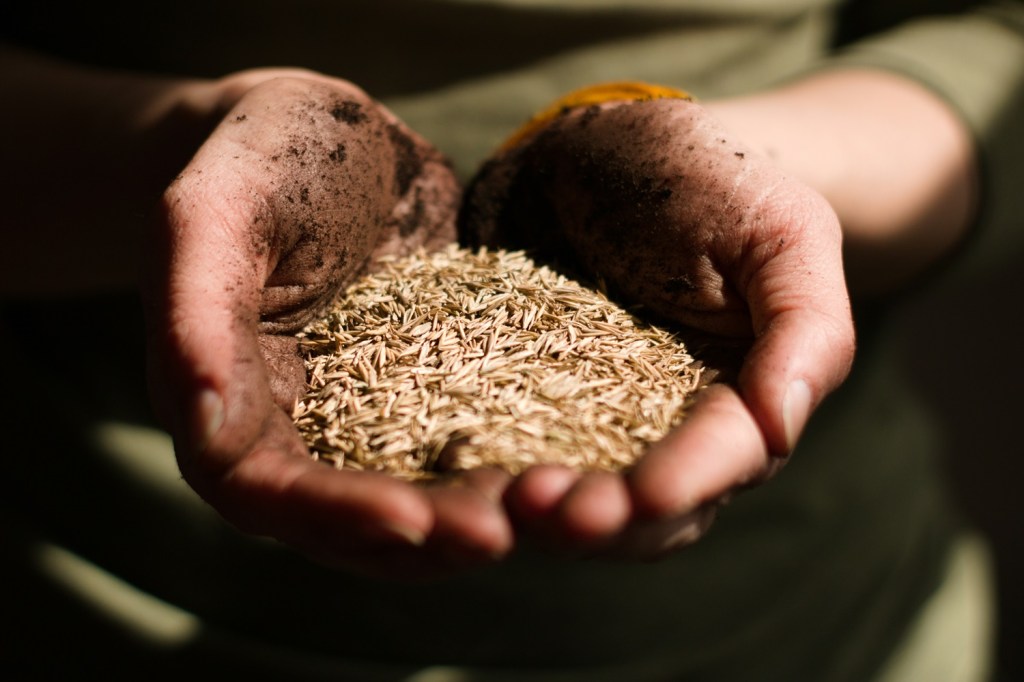
There are a lot of elements that go into farming–seeds, soil, weather, timing, harvest. But in the Parable of the Sower/Soils, Jesus simplifies spiritual farming to two things: seed and soil. The previous post looked at the soil. This post looks at the seed and its power and potential.
There’s a lot that goes into farming, from the seeds to the soils to the weather to the work that happens–cultivating, watering, caring for that plant as it comes up, and harvesting it. But Jesus really simplifies things in this parable. He boils things down to two elements: the seed and the soil.
In the previous post, we looked at the soil and the fact that good soil holds fast to the seed. It retains it and produces a crop from it.
Today, let’s look at the seed, which Jesus clearly tells us is God’s Word. So don’t conflate this with other farming parables (like the one about the mustard seed in which the seed is faith).
Notice that the soil itself does not have any life in it. The soil is just dirt. It’s not until the seed gets in the soil and goes down deep that it has any kind of impact.
It could be easy to look at this parable and think, okay, if I’m not producing the type of crop that I want to see, then I just need to work harder. I need to do better. I need to do more things for God. But that’s not the point here. The soil doesn’t do anything on its own. It is only when the soil takes in the Word of God that a crop is produced. The Word of God has power. Not the soil.
One might also think there is a problem with the seed because three of the soils don’t produce anything. In the same way, when we read difficult things in the Word of God, we might think there’s a problem with it. We might be tempted to ignore the parts that we don’t like.
But the seed is not defective. The problem is not God’s Word. It’s an issue with the soil and whether the soil takes that Word in and retains it. Because when the good soil does retain it, it produces a hundred times more than what was sown. The seed has an exponential impact on the good soil. There is such great potential in the Word of God to do far more than you can imagine.
There are no other farming elements included in this parable. It doesn’t talk about the weather or tilling or weeding or watering or harvesting. Because God’s Word cannot be constrained by those other elements.
It can be easy to look at our circumstances and think, if we just weren’t in this situation, we would produce more fruit. If life just wasn’t this difficult, things would go better. But God’s Word is powerful enough to overcome those other things that we may encounter.
Notice, too, that this seed is scattered everywhere. The farmer is not super precise in where he’s sowing it. It’s landing on paths and rocky soil and thorny soil and good soil. It’s all over the place.
We see this as Jesus is traveling from town to town, sharing about the Word of God. We’ve noted how he tends to teaching in synagogues on the Sabbath. When they tried to keep him in one town, he said, no, I need to travel and tell others.
Jesus was so generous in sharing the Word of God wherever he went. It was available to everyone; to the Pharisees who hated him and wanted to murder him, to those who were just there to see a miracle, to his disciples. It was available.
Today, we have so many opportunities here to encounter God’s Word and engage with it. Are we taking advantage of all of those opportunities?
In the previous post, we noted that the seed must be retained by the soil in order to have an impact. Hearers must hold onto God’s Word. It can be easy to approach God’s Word as something that we take in when we can. Maybe when we go to church, that’s enough. Maybe we read a psalm when we’re feeling bad and it perks us up. Maybe we even go through seasons of studying it and then seasons of not.
I had a period of about 10 years or so where I was more miss than hit with engaging with God’s Word. I didn’t spend time reading it on my own, trying to learn it. And during that time, I noticed that I was more susceptible to worry and fear and anxiety, that I kept thinking of all the good things that I should be doing, but I couldn’t juggle them all at once. I was trying to produce crops without seed, and that doesn’t work. Because the potential and the power come from the Word of God.
That’s what produces results. That’s what sustains us. That’s what roots us and gives us the moisture we need to grow. That’s what creates impact, not our own efforts, not trying harder. It’s the Word of God.
Our key truth for today is that the power and potential are in the Word of God.
That’s where we find power for transformed lives. That’s where we see potential for exponential growth beyond what was expected.
My parents were missionaries in Brazil for many years–they moved there just before I graduated college. When they moved down to Brazil and they were studying Portuguese, they were also discipling other believers. Their limited Portuguese sometimes made it difficult for them to express what they wanted to the people they were discipling. But my mom talks about how instead of this being a hindrance, it taught them to depend on the Word of God in those discipleship relationships. Instead of using their own words, they would point to passages in the Portuguese Bible to guide their disciples.
When you share your faith with someone, it can be so easy to get worried and hung up on, am I going to have all of the right words to say? And we forget that the power and the potential are in God’s Word, not our own words. When it lands in hearts that receive it and retain it, incredible transformation happens.
Today as you go, share this story with someone else. And trust that as God’s Word lands, if their heart is good soil, it will have an incredible impact on them, because the power and the potential are in God’s Word.
 Amy C Walters
Leave a comment